
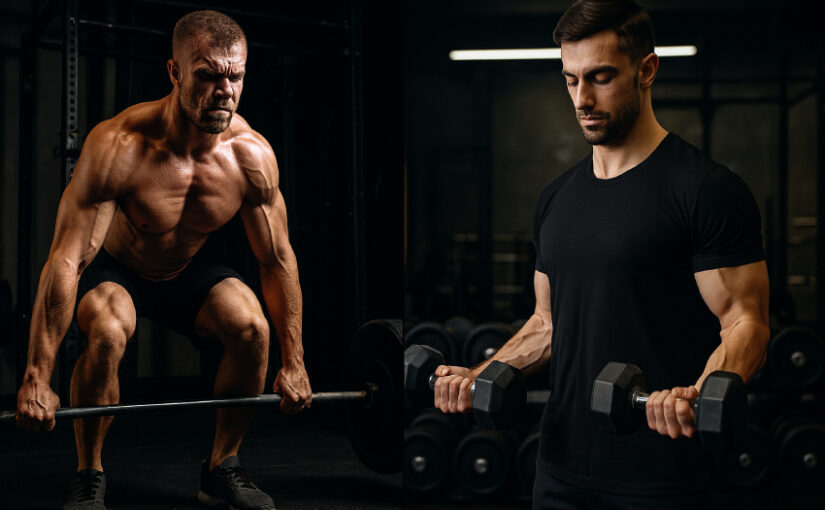
When discussing muscle growth, a frequently asked question among individuals is: Do I need to lift heavier to get bigger? The short answer is—not always, but progressive overload, including lifting heavier over time, does play a significant role in muscle growth. In this article, we’ll break down the science, explain what really matters for hypertrophy (muscle growth), and help you understand the best strategy for achieving size gains.
Understanding Muscle Growth (Hypertrophy)
Muscle hypertrophy occurs when muscle fibers experience stress and adapt by increasing in size. This stress can come from a variety of training methods, but the most effective approach usually involves increasing tension on the muscle over time—a concept known as progressive overload.
There are three key drivers of hypertrophy:
- Mechanical tension – the load placed on muscles during resistance training.
- Muscle damage – microtears that occur from challenging the muscle.
- Metabolic stress – the “burn” sensation you experience during sets with high repetitions.
So, where does lifting heavier fit in?
Do I Need to Lift Heavier to Get Bigger?
To answer the question clearly: Do I need to lift heavier to get bigger?—lifting heavier is one method of progressive overload, but it’s not the only one.
Why Lifting Heavier Can Help
- More tension: Heavier weights increase mechanical tension, a strong stimulus for growth.
- Progress tracking: Adding weight to your lifts shows strength progression, often correlated with increased muscle mass.
- Time efficiency: Heavier weights with lower reps can produce results faster for some individuals.
But It’s Not Mandatory
Many lifters build impressive physiques using moderate weights with higher volume and perfect form. In fact:
- Studies show that training with lighter weights (30–50% of 1RM) to failure can still produce significant muscle growth.
- Muscles respond to total training volume, not just weight.
- Form, tempo, rest time, and intensity matter just as much—sometimes more—than simply adding more weight.
How to Apply This to Your Workouts
Instead of asking, “Do I need to lift heavier to get bigger?” ask:
- Am I progressively overloading in some way?
- Am I pushing myself close to muscular failure?
- Am I using good form and proper recovery?
Here are a few ways to build muscle without constantly increasing the weight:
- Increase reps with the same weight.
- Slow down tempo (e.g., 3 seconds down, 1 second up).
- Reduce rest time between sets to increase metabolic stress.
- Add more sets over time to increase volume.
Lifting Heavier vs. Other Hypertrophy Strategies
| Approach | Pros | Cons | Best For |
|---|---|---|---|
| Lifting Heavier (Low Reps) | – Increases mechanical tension- Efficient strength gains- Easier to track progress | – Higher injury risk- May require longer recovery- Not ideal for beginners | Intermediate to advanced lifters focusing on strength and size |
| Moderate Weight + High Volume | – Lower risk of injury- Increases training volume- Great for metabolic stress | – Requires longer sessions- Progress tracking can be slower | Beginners to intermediate lifters aiming for hypertrophy |
| Light Weight to Failure | – Accessible for all fitness levels- Effective when taken to failure- Enhances muscle endurance | – Can be mentally taxing- More reps required to achieve fatigue | Home workouts or deload phases |
| Tempo & Form-Focused Training | – Improves mind-muscle connection- Less joint stress- Enhances control and stability | – Requires more focus- Progress may feel slower | All levels; great for improving technique and activation |
Conclusion: Do I Need to Lift Heavier to Get Bigger?
So, do I need to lift heavier to get bigger? Lifting heavier can help you grow, but it’s not the only path to muscle gain. The key is progressive overload—whether that means adding weight, doing more reps, increasing sets, or improving your training intensity.
If your goal is muscle size, focus on consistent progression, proper technique, and recovery. Heavier weights are a tool—not a rule.
Frequently Asked Questions (FAQ)
Absolutely, muscle growth can be achieved with lighter weights as long as you train close to muscular failure. The key is applying enough tension and volume to challenge the muscles effectively.
Progressive overload involves gradually increasing the stress on the body during exercise. This can be achieved by raising the weight, repetitions, sets, or intensity over time.
Typically, 6–12 reps per set is considered the ideal range for hypertrophy. However, going outside this range—either lower or higher—can still be effective when paired with proper intensity and effort.
Absolutely. Proper form ensures you’re targeting the right muscles and reducing injury risk. Lifting with poor technique, even with lighter weights, can hinder progress and cause strain.
There’s no set timeline, but you should aim to increase the weight once your current load no longer challenges you or you can easily exceed your rep targets. This is a natural signal to level up your training.